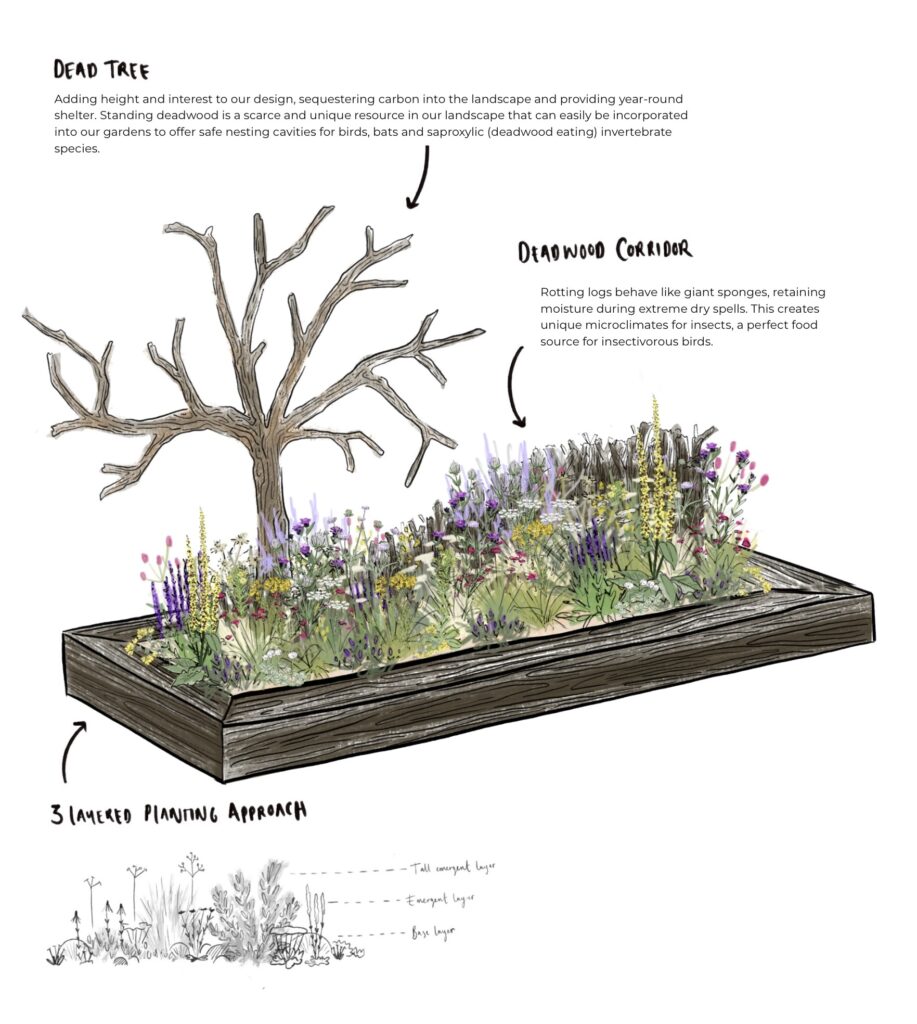
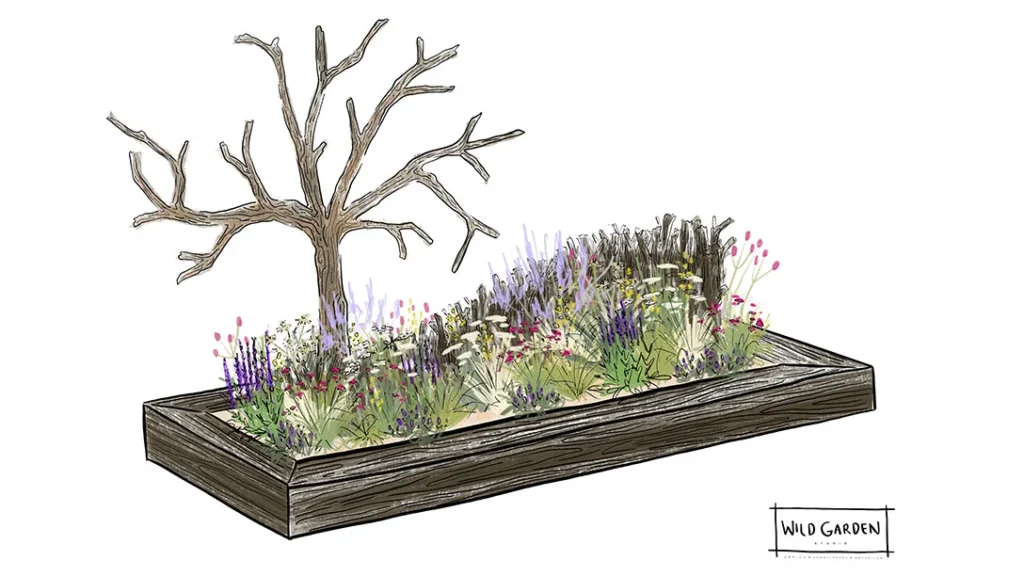
To celebrate the launch of Wild Garden Studio we will be creating a long border at RHS Sandringham 2026, called The Habitat Garden, we hope to demonstrate how biodiversity provisions can be designed and built into a climate resilient and beautiful border.
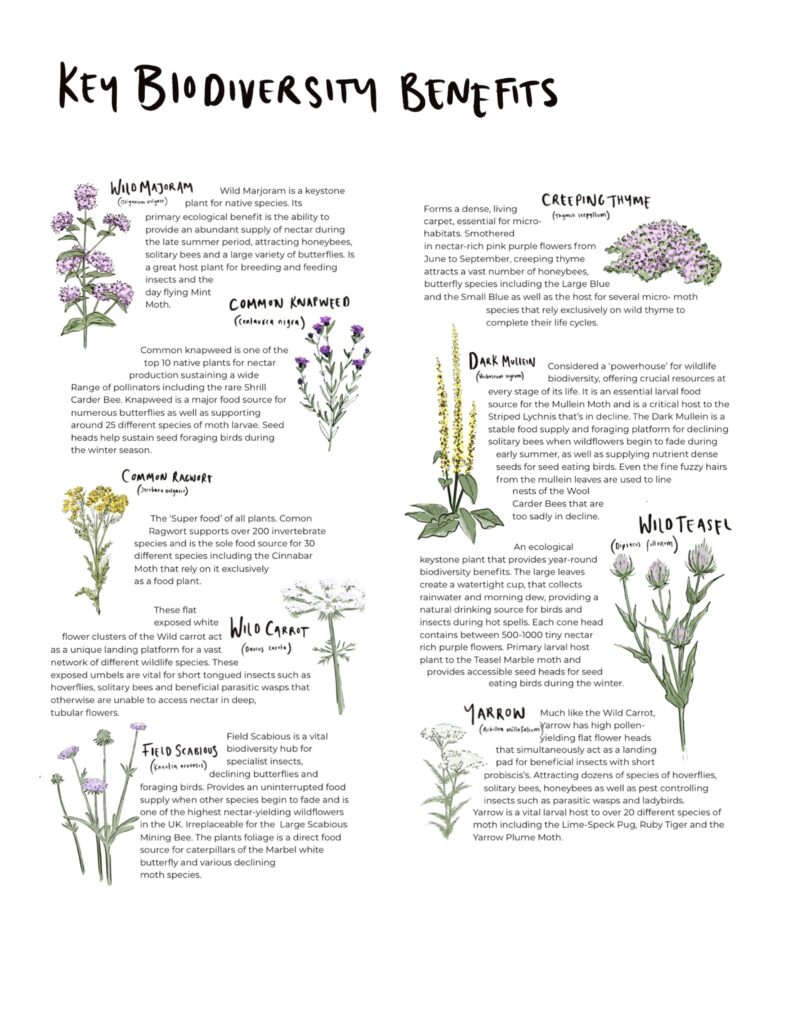
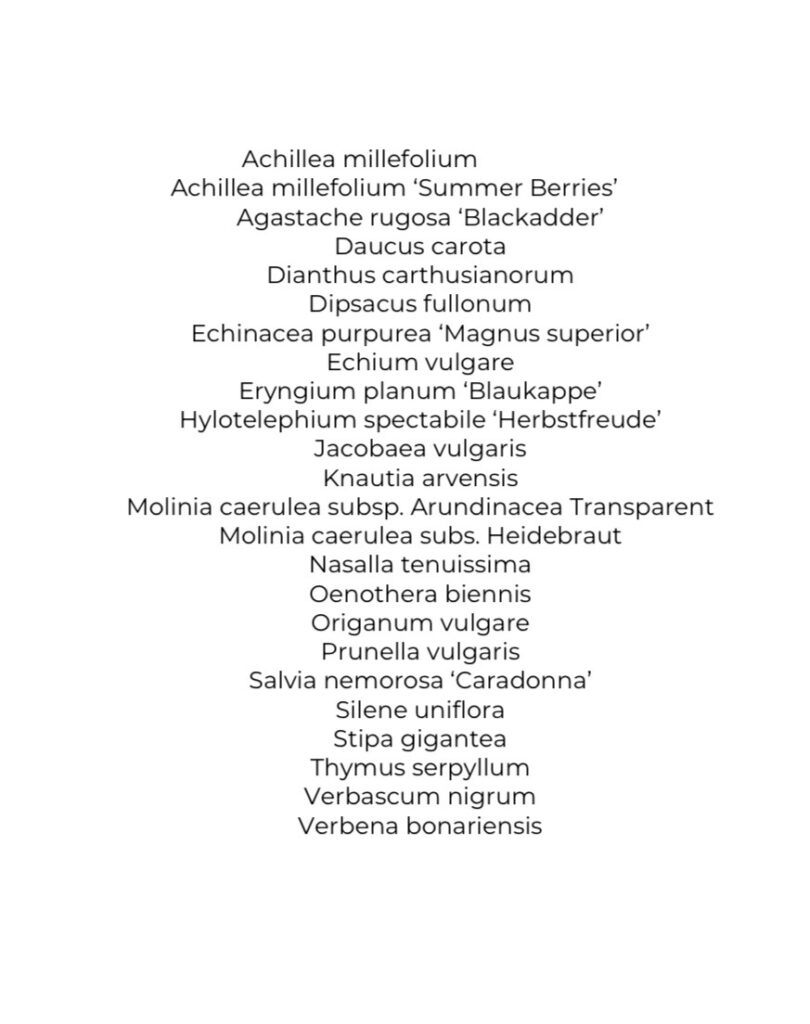
The Habitat Garden embraces current environmental and biodiversity challenges through an approach to garden creation that is both beautiful and beneficial. To reduce costs and maintenance needs, the space is planted as a naturalistic meadow that can be established from seed. A dynamic mix of native and non-native species, from Common knapweed to Evening primrose, creates a rich plant community that benefits wildlife, providing nectar for pollinators and food sources for insects and birds.
A standing dead tree and a deadwood corridor form the structural backbone. Not only is garden waste reused creatively, but this framework also provides habitat and vertical interest, offering a sense of natural permanence softened by the surrounding planting. Using sand as a medium we improve resilience to climate change while reducing the need for mulch, mains water and pesticides.
Tell me more ...
As summer 2026 fast approaches we have been busy behind the scenes preparing the launch of our new venture: Wild Garden Studio
With the simple goal of empowering people to connect with nature through their garden and build habitat to benefit local ecosystems.
Gardens within the UK have the potential to play a key role in restoration of habitat and halting the declines in biodiversity and yet is all too common to see gardens created which are biodiversity deserts often at huge costs to the environment.
We wanted to be part of the solution and so with the launch of Wild Garden Studio we hope to play our part changing the way people build, manage and appreciate gardens as places where connection to nature is embedded from the outset.
Our Garden Design process integrates our clients needs with nature-based design so gardens are shared spaces which benefit both people and wildlife. The scientific research into the role gardens play for biodiversity is fairly advanced and so by incorporating specific elements, structures and types of planting we can turbo charge the role these spaces have as habitat. The design of these elements becomes the key factor in making them beautiful, often as focal points within a garden.
We tailor our design service to your needs, for some projects a full design package is needed this includes concept plans, master plans, construction plans and planting plans. For other project particular elements become more important and so we can include just these elements, your needs are explored within an initial phone conversation with Jonathan.
If you are interested in collaborating with us with the design of your garden space we would love to hear from you.
Jonathan offers garden consultations and coaching for clients who want to incorporate more habitat within their garden and want to be actively involved in its creation. These in person sessions allow us to talk through your existing garden and explore new ideas and planting to maximise the biodiversity offering from your garden. With years of practical experience in garden building and management the advice is always very practical and achievable.
If you are interested in booking a garden consultation email us: hello@wildgardenstudio.co.uk
Are you in the garden design or garden maintenance business and looking to incorporate sustainability and biodiversity? Jonathan offers professional consultations to explore practical and profit generating changes you can make within your business to be benefit the planet.
Jonathan also works as a planting consultant for Landscapers and Landscape Architects bringing projects to life with interesting and biodiversity planting design. These schemes often contribute to the biodiversity net gain of a project. For more information on our professional consultancy services contact us hello@wildgardenstudio.co.uk
As part of our commitment to being part of the solution, Jonathan often runs workshops and talks on designing, building and managing gardens sustainably and in a way which incorporates biodiversity, for more info on these please email hello@wildgardenstudio.co.uk
As we kickstart Wild Garden Studio we would love to hear from you:
Email: hello@wildgardenstudio.co.uk
Phone: 07875 462126
Instagram: Wild.Garden.S
Facebook: Wild Garden Studio
Within the UK domestic gardens cover 959 800 hectares, an area more than three times larger than that of our national nature reserves. This area means gardens are vital to help reverse the biodiversity crisis. Gardens provide food, shelter and nesting sites for birds, mammals, insects, amphibians, and reptiles and despite their small size (compared to the open countryside) it is common for a single garden to contain multiple habitats within its boundaries. It is easy to imagine a single garden which has a pond (wetland habitat) area of long grass (meadow habitat), a hedge line (scrub habitat) and trees (a woodland habitat) all within a relatively small space.
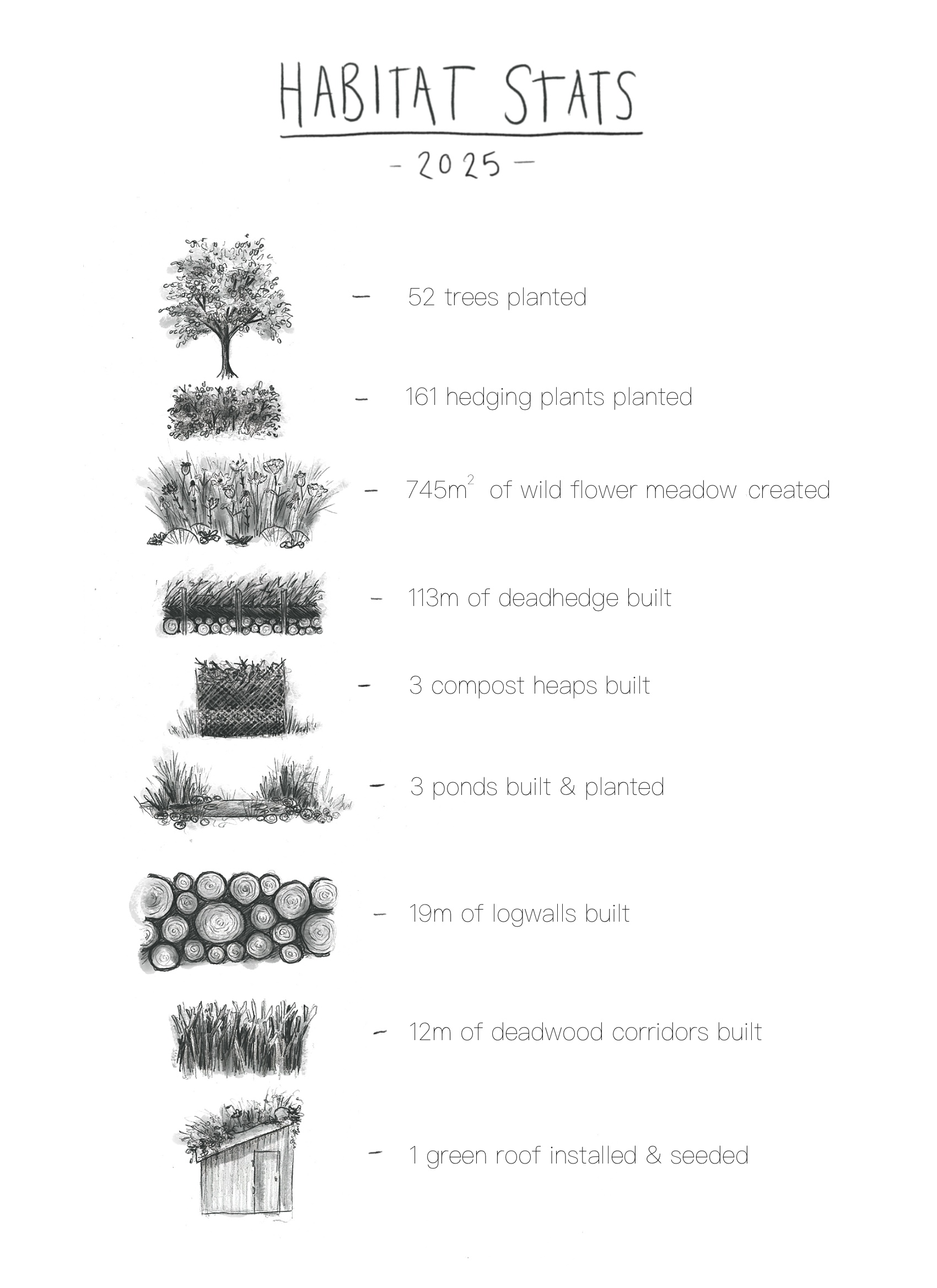
Over the last few years our business has shifted its focus to creating gardens with as much biodiversity habitat within them as possible. There are proven features and styles of planting which have been linked to biodiversity provision and we have used these wherever possible and measured these as key statistics to see how we are doing.

Trees planted: Trees can support many animal species who use them for food, shelter and nesting sites.
Hedges planted: Wildlife is often looking for complex vegetation to live and feed among, hedges are a key place for nesting, shelter and feeding.
Wildflower meadows: Add to the variety of plant species present within the garden with a wide range of native flowers and grasses growing within them. They are used by pollinators and as a food plant for the larval stages of some butterfly species. Longer areas of vegetation also make great habitat for small mammals
Dead hedges: Made up of dead woody material (twigs) laid horizontally dead hedges are a great way to reuse waste within the garden and create habitat for small mammals as well as saproxylic insects (those which rely on deadwood as part of their lifecycle)
Compost heaps: A great way of reducing waste and gardening regeneratively, compost heaps also become a habitat for many insects, soil organisms and reptiles
Ponds: One of the most beneficial features in a garden pond planted with native plants are used by many species of animals.
Log walls: Using waste creatively to benefit saproxylic insects, log walls can also become a structural element within a garden
Deadwood corridors: Another way of incorporating deadwood into gardens, standing deadwood is a vital habitat missing from the wider landscape, including this within gardens can be hugely beneficial to biodiversity
Green roofs: Offsets the space taken by a building allowing native grasses and wildflowers to be grown on top of them each in turn becoming a habitat of their own.
Are you looking to build biodiversity provision within your garden?
Death within our landscapes is often quickly removed; standing dead trees are felled, fallen branches are tidied, leaves are raked, and dead stems and flower heads are cut off. This happens in both gardens and the open countryside where safety and tidiness are often cited as the motivation.

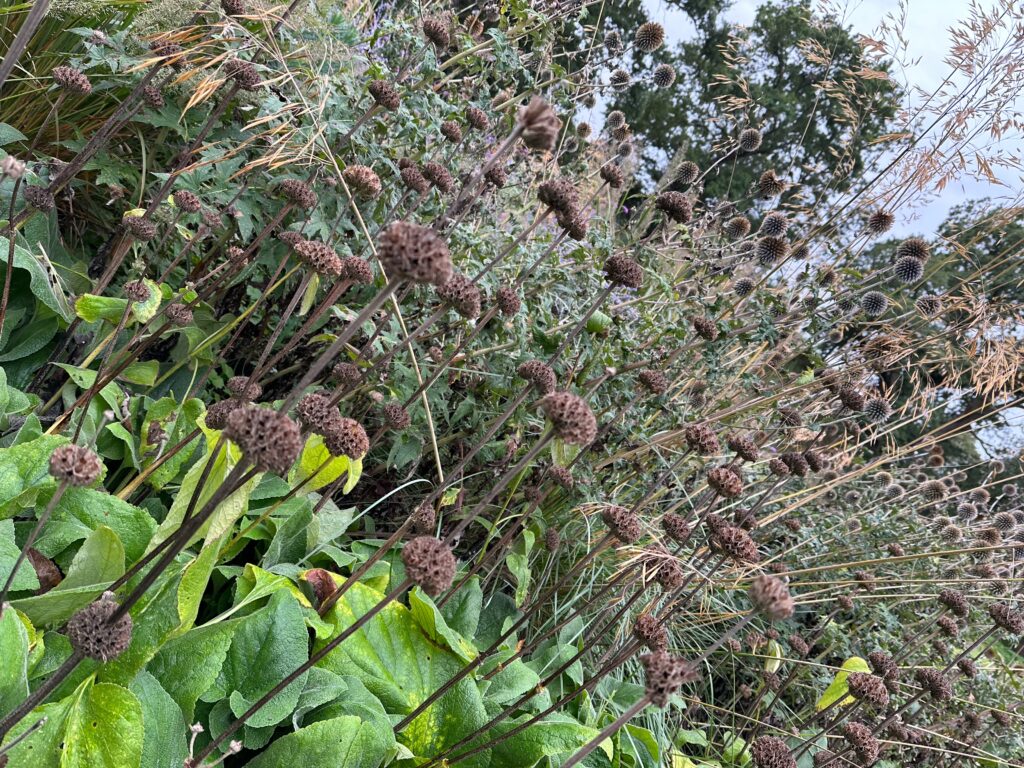
Flower heads left to offer structure and habitat into the winter months
By removing these elements from our landscape their function as a food source and shelter on which our wildlife relies disappears too. Some of the highest levels of biodiversity can be found where dead plant material is present. Compost heaps, leaf piles and decaying wood can host fungi, invertebrates, reptiles, and mammals while standing deadwood is a key resource to allow birds to forage and nest.
For most of us, gardens are spaces to escape, connect with nature and relax within. Incorporating these dead elements can intensify this connection as gardens become habitats filling your senses with the sights, sounds and smells of nature.
The potential for gardens to make a real contribution to nature recovery is huge and so within the gardens we create we maximise their habitat potential. This means we incorporate deadwood wherever possible, this can be an architectural dead tree, perimeter dead hedge, habitat rich deadwood corridor or log pile ready for saproxylic insects to eat.
These structures become focal points, boundaries and sculpture often connecting the garden to the surrounding landscape.


Deadwood Corridor in John Little’s garden (@grassroofco) and Log piles in Nigel Dunnet’s garden (@nigel.dunnett).
Creates habitat: Many species rely on deadwood within their home range to eat, nest and
shelter in.
Creates a sense of space: Particularly within rural gardens deadwood connects you to the
surrounding landscape and anchors you in the space.
Re-uses a waste material: Sourced from within the garden using deadwood (often a waste material) reduces the carbon footprint when compared to disposing of that same material. In time, as it decomposes, the carbon which makes up the woody material is sequestered back into the soil.
Are you keen to incorporate nature into your garden? Create a space which benefits you and the local biodiversity? We would love to be involved!