Teasels Landscapes

Death within our landscapes is often quickly removed; standing dead trees are felled, fallen branches are tidied, leaves are raked, and dead stems and flower heads are cut off. This happens in both gardens and the open countryside where safety and tidiness are often cited as the motivation.
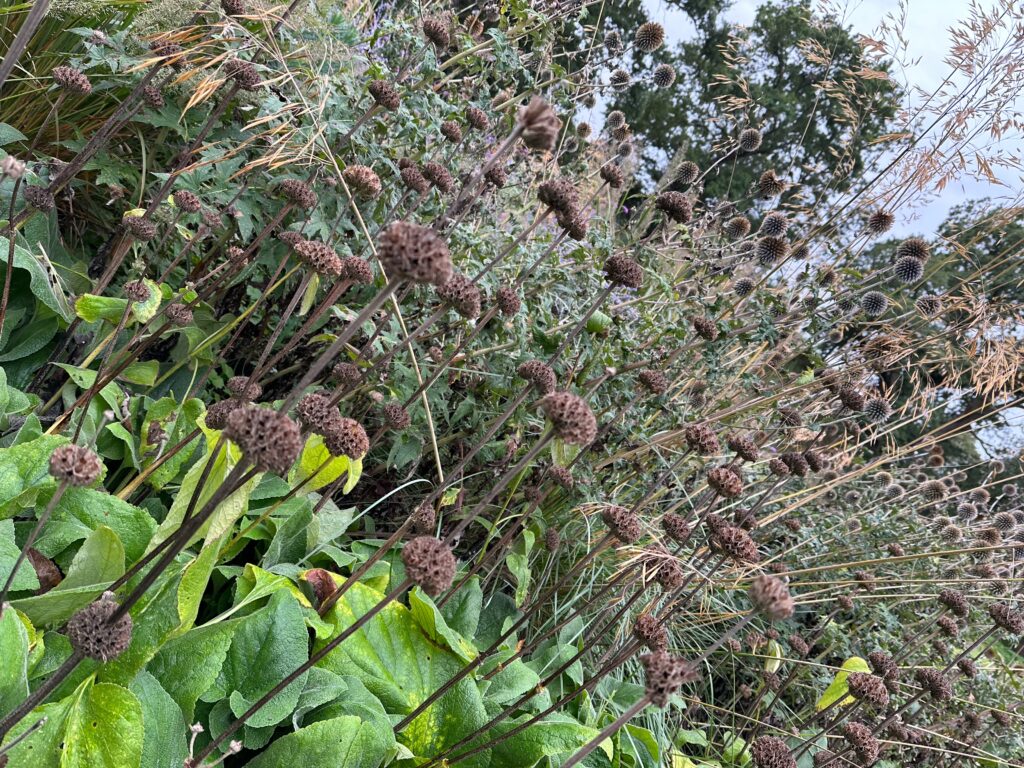
Flower heads left to offer structure and habitat into the winter months
By removing these elements from our landscape their function as a food source and shelter on which our wildlife relies disappears too. Some of the highest levels of biodiversity can be found where dead plant material is present. Compost heaps, leaf piles and decaying wood can host fungi, invertebrates, reptiles, and mammals while standing deadwood is a key resource to allow birds to forage and nest.
For most of us, gardens are spaces to escape, connect with nature and relax within. Incorporating these dead elements can intensify this connection as gardens become habitats filling your senses with the sights, sounds and smells of nature.
The potential for gardens to make a real contribution to nature recovery is huge and so within the gardens we create we maximise their habitat potential. This means we incorporate deadwood wherever possible, this can be an architectural dead tree, perimeter dead hedge, habitat rich deadwood corridor or log pile ready for saproxylic insects to eat.
These structures become focal points, boundaries and sculpture often connecting the garden to the surrounding landscape.


Deadwood Corridor in John Little’s garden (@grassroofco) and Log piles in Nigel Dunnet’s garden (@nigel.dunnett).
Creates habitat: Many species rely on deadwood within their home range to eat, nest and
shelter in.
Creates a sense of space: Particularly within rural gardens deadwood connects you to the
surrounding landscape and anchors you in the space.
Re-uses a waste material: Sourced from within the garden using deadwood (often a waste material) reduces the carbon footprint when compared to disposing of that same material. In time, as it decomposes, the carbon which makes up the woody material is sequestered back into the soil.
Are you keen to incorporate nature into your garden? Create a space which benefits you and the local biodiversity? We would love to be involved!
